

Aircon Gas Top Up Singapore - R22, R32 and R410A Refill
Aircon gas top up in Singapore from S$50. R32, R410A and R22 refrigerants. NEA-certified handlers, same-day leak detection and 90-day warranty.
Why a Low-Charge Aircon Cannot Cool Your Room
The refrigerant circuit is the heart of every split-type aircon in Singapore. A compressor in the outdoor unit pumps refrigerant through copper piping to the indoor coil, where it absorbs heat from the room air, then carries that heat back outside to be dumped into the atmosphere. When the refrigerant charge falls below the manufacturer’s specification, the whole heat-transfer cycle collapses. The compressor works harder, SP utility bills climb, and the air coming out of the vent is barely cooler than the room itself.
CoolX Aircon has been restoring refrigerant charge in Singapore aircon systems since our founding in 2016 by Mr Kok Wai Keong, who brought 15 years of prior industry experience into the business. Our team has now completed more than 2,400 projects across HDB flats in Tampines and Punggol, condos in Jurong East and Woodlands, and commercial premises across the island. Gas top-up is one of our most frequent call-outs, but also one where we reject the most jobs, because topping up a leaking system is throwing money away.
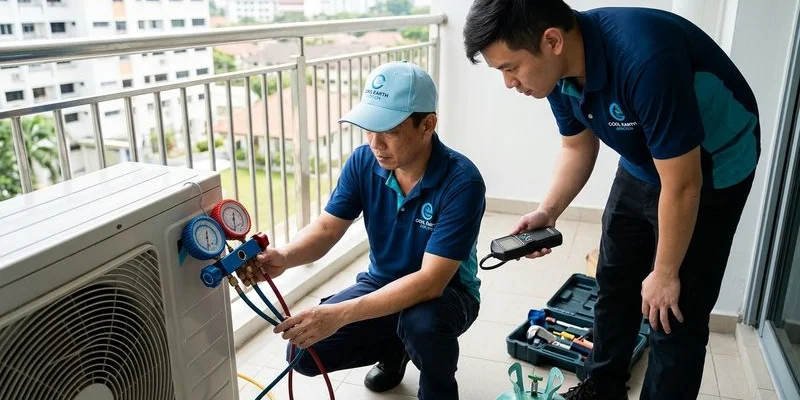
The Symptoms That Point to Low Refrigerant
Before you pay for a site visit, check for these classic signs. If more than one is present, low gas is the likely culprit.
Weak Cooling Despite Clean Filters
You set the remote to 22 degrees Celsius, the compressor is running, the fan is spinning, but the room never quite gets comfortable. Filters are clean because you just serviced the unit last month. This is the clearest sign of an undercharged system.
Ice on the Copper Piping
When refrigerant is low, the evaporator pressure drops below the freezing point of water, and moisture condenses and freezes on the copper piping at the outdoor unit. If you see frost on the larger suction line, stop running the unit and call us. Running an icing system stresses the compressor.
Unit Runs Non-Stop Without Reaching Set Point
An inverter compressor should modulate down once the room reaches the target temperature. If yours is running flat out for hours and never hits the set point, the system cannot transfer enough heat, usually because the charge is too low or the coil is badly fouled.
Hissing or Bubbling at the Outdoor Unit
A small gas leak sometimes produces an audible hiss at a flare joint or service valve. Bubbling sounds inside the piping can indicate refrigerant flashing in the line due to low charge.
Higher Electricity Bills
A low-charge inverter aircon pulls more watts than a correctly charged one because the compressor runs longer and harder. If your SP utility bill has climbed 15 to 30 percent without a change in usage, have the charge checked.
Our Gas Top-Up Procedure, Step by Step
Pre-Arrival Triage on WhatsApp
Send a short video of the indoor airflow and a photo of the outdoor unit. In over half the cases we can tell you before dispatching a technician whether you actually need a gas top-up, a chemical wash or a leak repair. That saves you a wasted site visit fee.
Calibrated Pressure Measurement
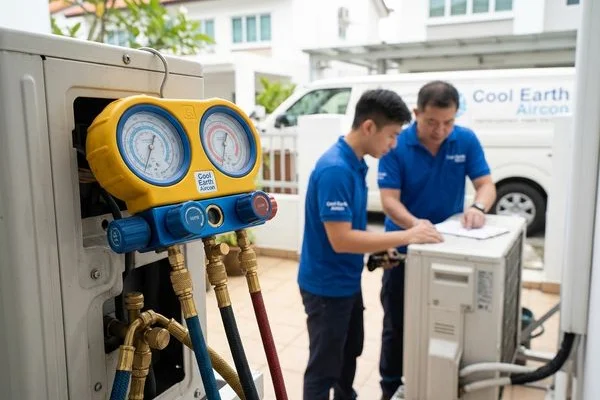
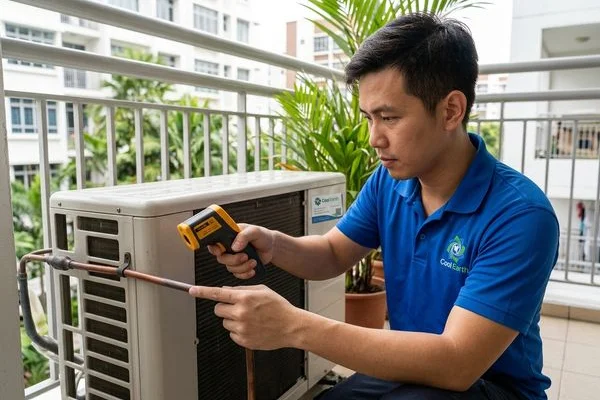
On site we connect a calibrated manifold gauge set to the service valves on your outdoor unit. We measure both the high-side discharge pressure and the low-side suction pressure and compare them against the manufacturer’s specifications for your specific model and refrigerant type. These readings tell us exactly how much charge the system currently holds.
Leak Detection Before Any Top-Up
If the reading is significantly below specification, we inspect for leaks before we add any gas. Common leak points in Singapore installations include:
- Flare joints at the indoor and outdoor unit connections
- Service valve stems at the outdoor unit
- Braze joints along the piping run
- Evaporator coil corrosion in older units near the coast
We use soap-bubble testing and an electronic leak detector to pinpoint the source. If a leak is found, we stop and discuss the repair options honestly before adding any refrigerant.
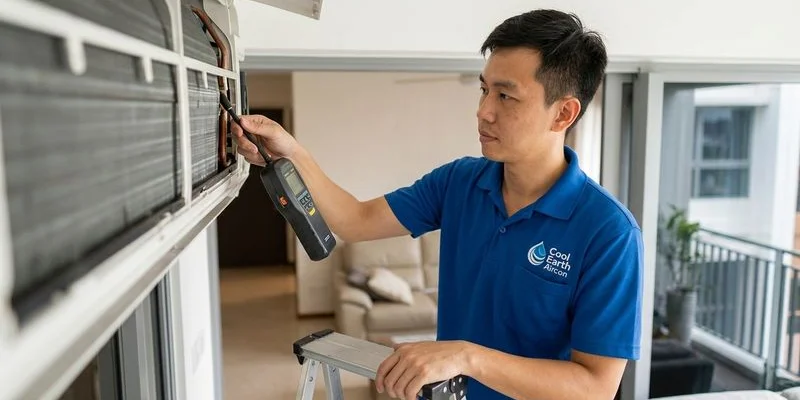
Precise Charging to Factory Spec
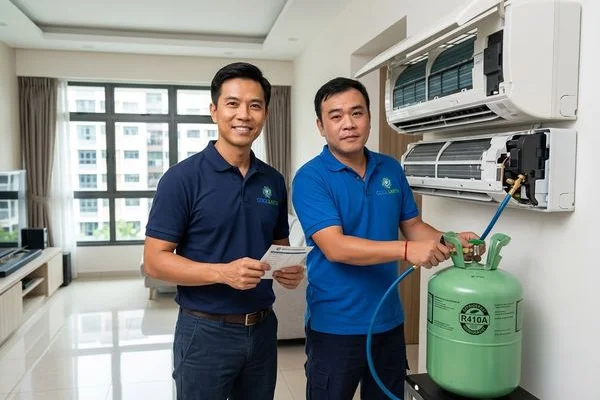
Refrigerant is metered in slowly while we watch the gauge readings. The goal is the exact factory charge, not more and not less. Overcharging causes high head pressure, reduces efficiency and can permanently damage an inverter compressor. Undercharging means you will be calling us back in a month. For Daikin, Mitsubishi Electric, Panasonic and Fujitsu systems we follow the exact factory charging tables.
Performance Verification
After charging, we measure the supply air temperature, suction line temperature and the differential between return and supply air. A healthy split system in Singapore should deliver a 8 to 12 degree Celsius differential and supply air at 14 to 18 degrees Celsius.
R22, R410A and R32 in Singapore Today
Different systems take different refrigerants. Using the wrong type is an expensive mistake.
R32 is the current NEA-preferred refrigerant. Most residential Daikin, Panasonic and Mitsubishi Electric units sold in Singapore from roughly 2020 onwards run on it. Lower global warming potential and better energy efficiency, but mildly flammable, so handling requires training.
R410A is the workhorse for units installed between 2010 and around 2020. Operates at higher pressure than R22 and still widely available.
R22 is the legacy refrigerant being phased down globally under the Montreal Protocol. NEA supply is tight in 2026 and prices have climbed accordingly. If your system is on R22 and it is over 10 years old, we will usually recommend replacement over top-up.
When a Top-Up Is the Wrong Answer
We believe in honest diagnostics, which sometimes means telling you that the thing you called us for is not what you actually need.
- Recurring low gas. If you topped up in the last 6 months and it is low again, you have a leak. Repeated top-ups are a waste of money and a NEA compliance issue.
- Dirty coil masquerading as low gas. A fouled evaporator coil produces the same weak-cooling symptoms as low charge. In that case a chemical wash is the real fix, not gas.
- Old R22 system. The cost of R22 plus repeat top-ups may exceed the cost of a new R32 5-tick inverter that will pay back in electricity savings.
- Struggling compressor. Grinding or labouring noises from the outdoor unit point to mechanical issues that gas cannot fix.
How We Compare
| Feature | Typical Provider | CoolX Aircon |
|---|---|---|
| Leak check before top-up | Often skipped | Always included |
| Calibrated gauges | Not guaranteed | Annually calibrated manifold set |
| NEA certification | Varies | NEA certified R32 and R410A handlers |
| R22, R32, R410A stock | Limited | All three carried on every van |
| Warranty | 0 to 30 days | 90-day workmanship warranty |
Same-Day Aircon Gas Top-Up Across Singapore
If your aircon is running but not cooling, WhatsApp us at 9051 7637 or email hello@coolxaircon.com. Our technician can usually diagnose the likely cause over chat, confirm pricing and dispatch the same day for most areas, including Tampines, Jurong East, Woodlands, Punggol, Bedok and Clementi. Every gas top-up job from CoolX Aircon carries a 90-day workmanship warranty and is handled by NEA-certified refrigerant handlers.
What's Included
Every service is thorough, transparent, and backed by our warranty.
Calibrated manifold gauge measurement
R32, R410A and R22 carried on every van
Electronic and soap-bubble leak detection
Manufacturer-specified charge quantities
Temperature differential testing
Honest top-up vs leak-repair advice
NEA certified refrigerant handlers
90-day workmanship warranty
How It Works
Our straightforward process from booking to completion.
Pre-Arrival Triage
Send us a WhatsApp video of the indoor vent airflow and a photo of the outdoor unit. Our technician can usually tell before dispatch whether you need a top-up, a chemical wash or a leak repair.
Gauge Readings
On site we connect a calibrated manifold gauge set to the service valves and record both the high-side discharge pressure and the low-side suction pressure against factory specifications.
Leak Inspection
If the charge is significantly low we run a leak check at flare joints, service valves and the evaporator coil using soap bubbles and an electronic detector before adding any gas.
Precise Charging and Verification
Refrigerant is metered in slowly to reach factory charge. We then measure supply air temperature, suction line temperature and the return-to-supply differential to confirm correct operation.
Our Work
Why Choose CoolX Aircon
Leak-First Philosophy
A sealed system should not need regular top-ups. If you are calling us twice a year for gas, something is leaking. We find it first so your money goes into a repair, not into the atmosphere.
NEA Certified Handlers
Our team is NEA certified for R32, R410A and R22 handling, which matters because R32 is mildly flammable and the NEA phase-down of R22 carries its own compliance rules.
Calibrated Gauges, Not Guesswork
We calibrate our manifold gauges annually. Overcharging a modern inverter system by 10 percent is enough to damage the compressor, so precision is not optional.
What Our Customers Say
"Aircon was barely cooling at night. The CoolX technician found the gas was very low and spotted a small leak at the flare joint. He sealed the leak and topped up the gas. Back to cold air within an hour."
— Ahmad R., Woodlands
"Booked on WhatsApp and they arrived inside the hour. Clear pricing, calibrated gauges, R32 charge done on the spot. Paid by PayNow. Very transparent team."
— Jenny T., Pasir Ris
Frequently Asked Questions
How do I know if my aircon actually needs a gas top-up?
Why does my aircon keep losing refrigerant?
What is the difference between R22, R410A and R32 in Singapore today?
How often should a top-up be needed on a healthy system?
Can I top up my own aircon gas to save money?
My unit uses R22 and needs topping up. Is it worth it or should I replace?
Related Services
Chemical Wash
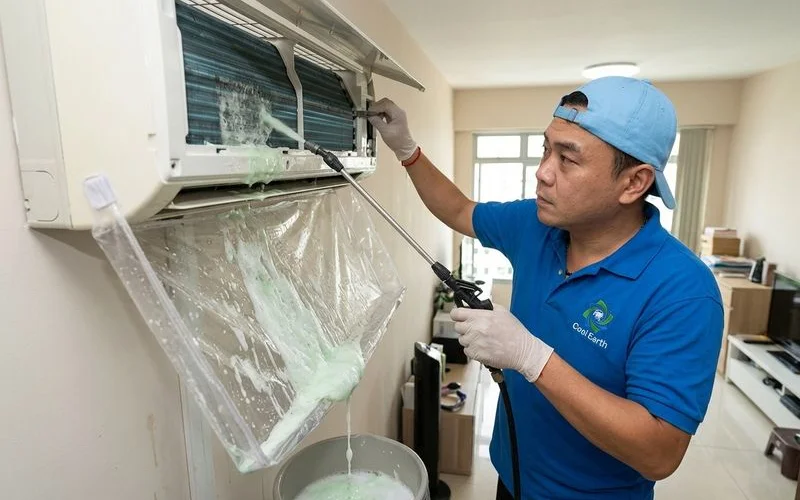
Professional chemical wash and chemical overhaul from S$80 per unit across Singapore. Removes jelly, mould and stubborn biofilm that routine servicing cannot reach.
From SGD80
Not Cold
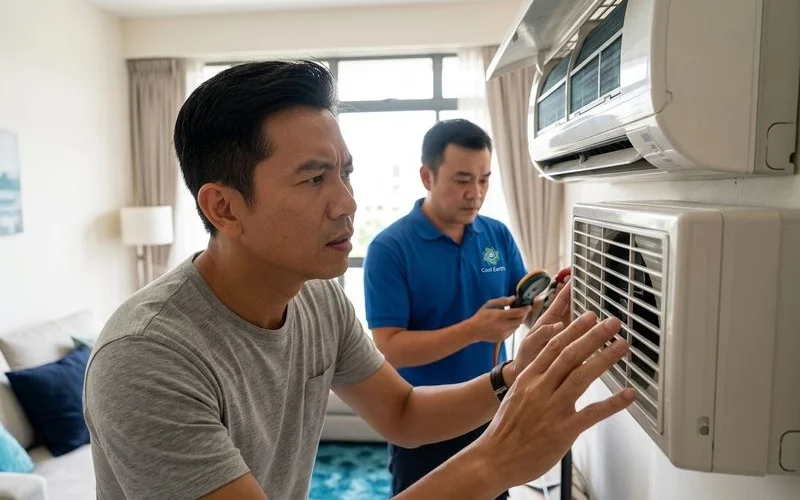
Aircon running but not cooling? CoolX Aircon diagnoses the real cause and fixes it from S$40. Low gas, dirty coils, thermistor and PCB faults covered across Singapore.
From SGD40
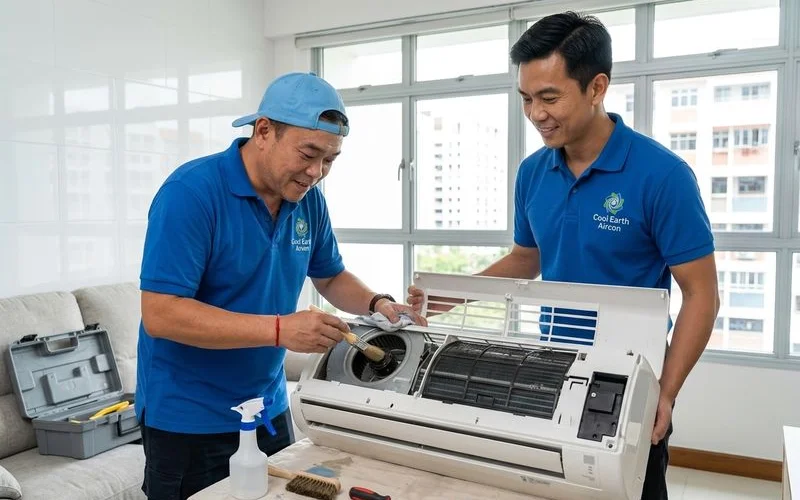
Servicing & Maintenance
Professional aircon servicing in Singapore from S$50 per unit with transparent pricing, 90-day warranty and same-day availability across HDB, condo and commercial properties.
From SGD50
Ready to Book Your Gas Top-Up Service?
Get in touch today for fast, professional aircon service with transparent pricing and our 90-day workmanship warranty.