
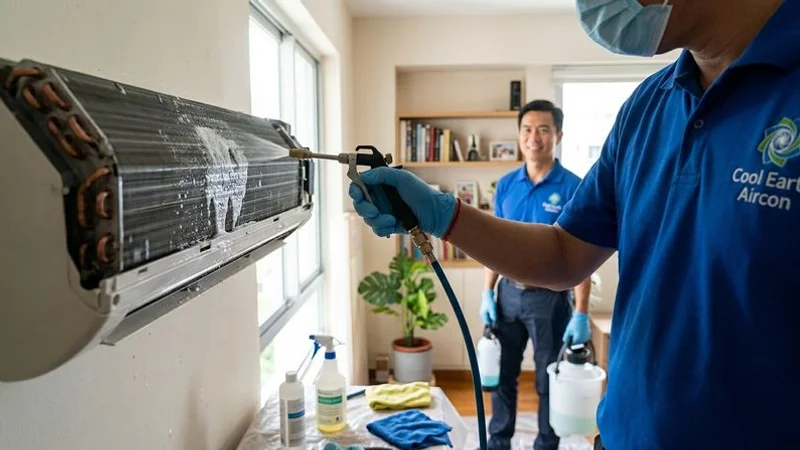
“Will the smell hurt my toddler?” “Can my cat stay in the living room while you work?” “What happens if some of that spray drifts into the next room?” These are the questions we field from worried parents every week at CoolX Aircon. They are fair questions, and they deserve a real answer rather than a brush-off.
This article breaks down what actually goes into a professional chemical wash, how the safety protocols work, and what precautions we recommend when children, elderly family members, or pets share the space.
The Two Main Classes of Cleaner
Professional chemical washes in Singapore rely on one of two types of cleaning agent. Knowing which one your technician plans to use is the first piece of information to confirm.
Conventional Alkaline Solutions
The traditional workhorse is a pH 11 to 12 alkaline blend, usually built around sodium hydroxide. It is extremely effective at dissolving greasy deposits and breaking down biological films on evaporator fins. This is the category most old-school contractors reach for, particularly on units that have been neglected for a year or longer.
The trade-off is handling. Direct skin contact causes irritation, so technicians must wear gloves and eye protection. The solution is also aggressive enough that prolonged contact with aluminium fins will corrode them, which is why proper dilution and rapid rinsing matter enormously.
Biodegradable Enzyme Cleaners
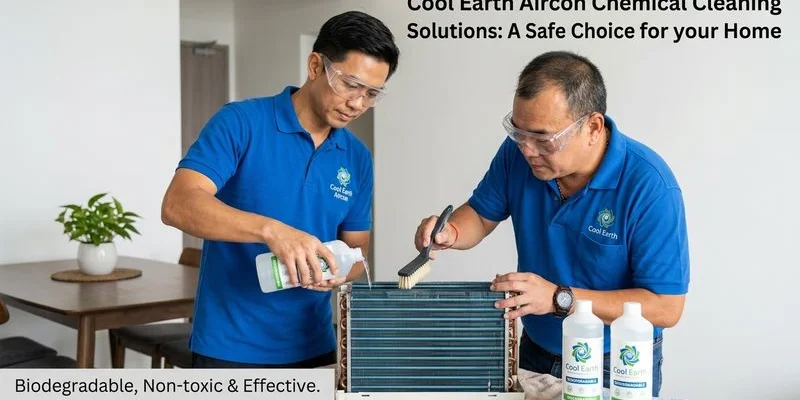
The alternative that has taken over much of the residential market in the last five years is a plant-based enzyme cleaner. These formulations use naturally occurring enzymes to digest organic grime without the harsh pH profile of alkaline solutions. Many carry the Singapore Green Label, which certifies them as non-toxic, non-corrosive, and free of synthetic VOC-releasing ingredients.
Our crews use enzyme cleaners as the default for residential work, upgrading to alkaline only when a unit is so heavily fouled that enzymes alone cannot cope. Enzyme treatments need a slightly longer dwell time (15 to 20 minutes versus about 10 for alkaline), but the additional wait is a reasonable trade for the peace of mind.
What About the Smell?
The most common safety concern we hear is the fear of lingering chemical fumes. Here is the honest answer: during the 10 to 20 minutes the cleaning solution is actively working, you may notice a mild scent similar to a household floor cleaner. Opening a window disperses it quickly.
Once the technician rinses the coils, the solution drains away through the condensate line. Modern cleaners are fully water-soluble and leave no airborne residue. Running the unit on fan mode for 10 minutes at the end flushes the housing completely.
The larger air quality story actually favours the chemical wash rather than the other way round. The National Environment Agency repeatedly reminds households that indoor air is often dirtier than outdoor air, and a fouled aircon is one of the main culprits. A proper wash removes the mould spores, dust mites, and bacterial colonies that accumulate in a damp blower housing. The short burst of mild cleaner smell is trivial compared to the biological load it eliminates.
Protecting Children and Elderly Family Members
Young lungs and older respiratory systems are more sensitive than the average adult’s, so extra precaution makes sense even when the cleaning agent itself is benign. About one in five Singaporean children has some form of asthma according to HealthHub data, and that population benefits from keeping a buffer between themselves and any cleaning activity.
Our standard recommendation is straightforward. Relocate sensitive family members to a different room while the work is happening, keep the service room door closed during the wash, and let the technician run a 10-minute fan cycle before anyone returns. Thirty minutes after the technician finishes, the space is ready for normal use.
For households with severe asthma or multiple chemical sensitivities, request an enzyme-only treatment and ask the technician to skip any optional antibacterial spray at the end. That combination keeps exposure to a minimum.
Protecting Pets
Pets are often the group we get asked about most. Cats and small dogs spend a lot of their time close to the floor, which means any settling mist reaches them first. Their senses of smell are also much sharper, so what registers as mild to a human can feel overwhelming to an animal.
Four rules keep things safe:
- Keep cats and dogs in a completely different room for the full duration of the wash
- Wait the same 30 minutes after completion before letting them return
- Make sure the technician removes the wastewater collection bucket before pets come back, so nothing curious gets a taste
- Cover fish tanks with a thick towel so no airborne alkaline mist reaches the water surface
Birds are the most sensitive category of pet in our experience. If you keep a parrot or canary, move the cage to a separate room with its own ventilation for several hours, not just during the wash itself.
Can the Aircon Itself Be Damaged?
This is the other half of the safety question, and it is a fair worry. The same chemicals that dissolve mould can also corrode aluminium fins if left sitting for too long. This is exactly why DIY chemical treatments tend to go wrong.
Here is what professional handling looks like in practice:
- Evaporator fins: aluminium tolerates brief alkaline contact but corrodes if the cleaner sits for more than 15 to 20 minutes. Technicians monitor dwell time carefully and rinse aggressively.
- Plastic housing: industrial-grade plastics used in modern fancoils resist both alkaline and enzyme cleaners without structural change.
- Electrical boards: the PCB and wiring must be isolated or physically covered before any liquid touches the unit. A good technician tapes the electrical zone off as the first step.
When these three points are handled correctly, the wash lengthens the life of the unit rather than shortening it. When they are mishandled, you can damage a unit that would otherwise have lasted another five years. That is the real reason we advise against DIY attempts, not any magic about the chemicals themselves.
The Bigger Risk Is Not Cleaning at All
Let us flip the question around. What happens to a unit that never gets a chemical wash?
Our crews regularly pull apart fancoils where the blower wheel is coated black with biofilm and the drip tray is swimming in algae. Every time that wheel spins, it blasts airborne microbes straight into the breathing zone of whoever is sitting in the room. The consequences accumulate slowly:
- Persistent cough or throat irritation that clears on weekends away from home
- Allergy flare-ups that seem worse indoors than outdoors
- Unexplained headaches that follow the aircon usage pattern
- Clothes that pick up a faint musty smell from bedroom air
None of those are dramatic, which is precisely why they get tolerated for so long. A proper annual wash resets the system and eliminates the slow drip of biological pollution.
Our Bottom Line
A professional chemical wash performed by a trained technician using proper solutions is safe for your family, your pets, and your equipment. The procedure itself is less chemically intense than mopping your floor with a strong detergent, and the resulting improvement in indoor air quality meaningfully outweighs the short-term precaution of staying out of the room.
What is not safe is letting an untrained installer experiment with the wrong chemicals, or buying a bottle of supermarket aircon foam and attempting a DIY version on a unit you do not fully understand. Our guide on chemical wash versus chemical overhaul explains which service your unit actually needs.
If you have specific concerns about children, pregnancy, or pets with respiratory issues, mention them when you book. Contact our team and ask for an enzyme-based treatment scoped to your household. Details on our full chemical wash service are listed openly on our site.


About the Author
Kok Wai Keong
Founder & Principal Technician
Mr. Kok founded CoolX Aircon Servicing in 2016 after 15 years handling commercial and industrial cooling systems. He leads a team committed to eco-friendly maintenance and transparent pricing.