
Ask ten different aircon companies how often you should service your unit and you will get ten slightly different answers. That is frustrating, because the question is perfectly reasonable. You just want to know the minimum upkeep that protects your comfort and your equipment without throwing money at unnecessary visits.
At CoolX Aircon, we have built our maintenance schedules around a single idea called the “Cool Earth” approach. The goal is to catch issues early, keep electricity waste low, and avoid the environmental cost of premature equipment replacement. Here is the schedule we use with our own clients.
Start With the Baseline: Once Every Three Months
For most residential users in Singapore, the practical baseline is a full service every three months. This frequency works because the climate never gives your system a break. Humidity averages 80 to 85 percent year round, and that moisture feeds mould, algae, and bacterial slime inside the blower housing.
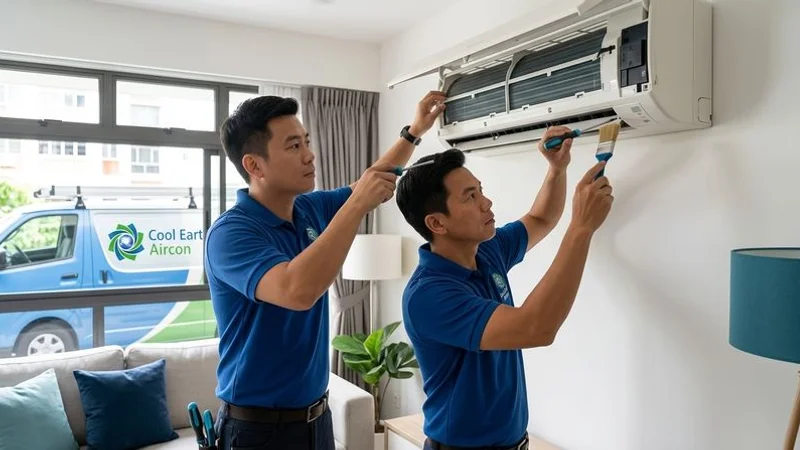
Basic servicing typically runs S$30 to S$50 per unit in 2026. What you actually get for that fee varies widely, so ask any technician to confirm these five things are included:
- Washing the primary mesh filters
- Inspecting and vacuuming the evaporator fins
- Flushing the condensate drainage pipe
- Checking refrigerant pressure for R32 or R410A
- Tightening and safety-checking electrical connections
National Environment Agency data shows aircon accounts for roughly a quarter of typical household electricity consumption. Even a modest efficiency loss of 10 percent translates into real money on your monthly bill.
The Variables That Change the Math
Three months is a starting point, not a rule. Four factors should push you faster or slower.
How Many Hours You Run It
Running aircon more than 12 hours a day forces servicing closer to every 8 weeks. The extra runtime pulls more airborne dust through the system and loads the compressor harder. Homes with young children, elderly family members, or full-time remote workers usually fall into this heavy-use category.
Light users who switch on for a few hours each evening can often stretch the interval to four months without obvious consequences. If you use aircon only occasionally during sleep hours, your system lives longer naturally.
Your Unit’s Environment
Location matters more than most people realise. High-floor units on breezy block faces stay cleaner because less street dust reaches them. Ground-floor flats near construction sites or busy expressways like the PIE or AYE clog their filters much faster.
Proximity to the coast introduces another variable entirely. Homes in waterfront neighbourhoods around Bedok or the East Coast absorb salt-laden air that accelerates corrosion on outdoor condenser fins. These units benefit from shorter inspection cycles regardless of how many hours you run them indoors.
Number of Indoor Units
A standard four-room flat runs three to four indoor blowers connected to one outdoor condenser. Booking every blower in a single appointment almost always unlocks package pricing, usually S$75 to S$100 for three units. This is not just cheaper, it is also cleaner for your system because balanced servicing prevents the common issue of one neglected unit dragging down airflow across the whole setup.
Pets in the Home
Dog and cat dander is invisible but ruthlessly thick. Pet owners who stick to a quarterly schedule almost always end up with matted fur inside the blower wheel. Shifting to a two-month cycle keeps airflow healthy and prevents the heavy chemical washes that overgrown fur accumulation eventually demands.
What Actually Happens If You Skip
Some users quietly delay maintenance for a year at a time, betting that nothing bad will happen. Unfortunately, the damage is cumulative and quiet.
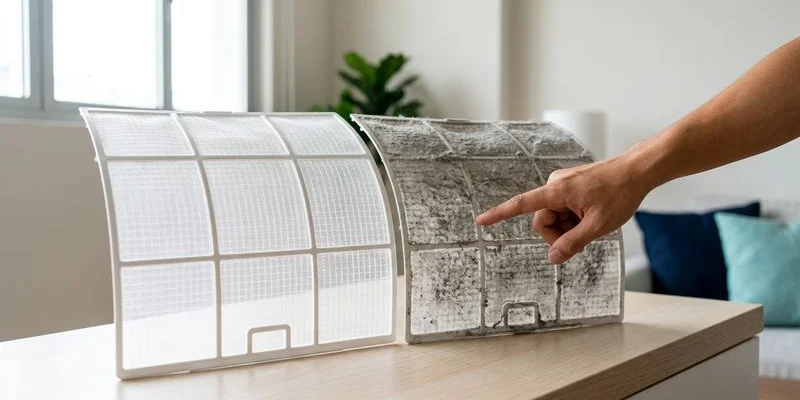
- Efficiency drops: Dust coats evaporator fins and you feel rooms taking longer to cool.
- Bills climb: Neglected systems often consume 20 to 30 percent more electricity than clean ones.
- Drainage fails: Algae builds into a jelly-like plug inside the PVC drain, leading to the classic dripping-from-the-wall problem.
- Indoor air quality drops: Dust mites and bacteria multiply inside the damp casing and get blown straight at your bed.
The drainage failure alone is worth the prevention. A single overflowing unit can destroy a parquet floor or ruin a mattress in one night.
Servicing, Chemical Wash, and Chemical Overhaul
Routine servicing is only one of three tiers, and each handles a different level of contamination.
| Service Type | Typical 2026 Cost | Best For |
|---|---|---|
| Regular Servicing | S$30 to S$50 per unit | Quarterly maintenance on a healthy system |
| Chemical Wash | S$80 to S$150 per unit | Annual deep clean for stubborn biofilm |
| Chemical Overhaul | S$150 to S$350 per unit | Severe neglect, recurring leaks, weak airflow |
Think of it as a ladder. Quarterly servicing handles surface dust. Annual chemical washes dissolve the sticky microbial grime that water alone cannot remove. Full overhauls are reserved for systems that have been ignored for years and need almost factory-level restoration.
Our Recommended Schedule
Here is the timeline we actually use with CoolX Aircon clients:
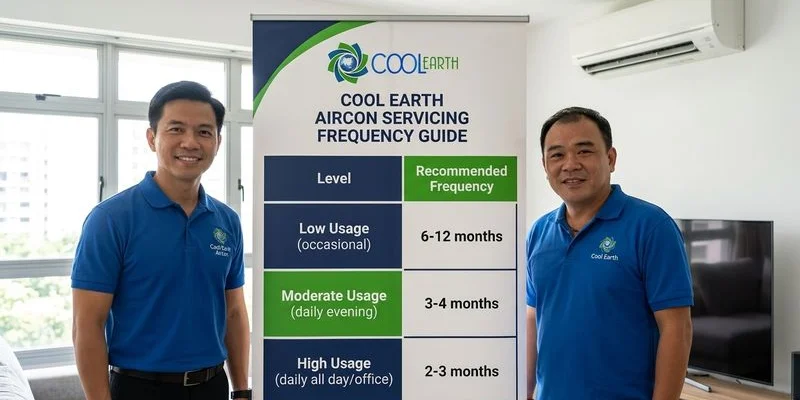
- Light residential use (under 6 hours daily): Service every 3 to 4 months
- Moderate use (6 to 12 hours daily): Service every 3 months
- Heavy use (more than 12 hours daily): Service every 2 months
- Annual chemical wash: Once per year for every household
- Full chemical overhaul: Every 2 to 3 years, or whenever airflow noticeably drops
A maintenance contract removes the mental load of tracking dates yourself. Our guide on annual contracts versus ad-hoc servicing breaks down when a plan makes financial sense.
Small Habits Between Services
You can also influence system health between professional visits. The NEA’s “Go 25” campaign urges households to set thermostats to 25°C, and every degree higher reduces power draw by roughly 10 percent.
Try these quick habits:
- Rinse primary filters with tap water every two weeks.
- Keep a 30cm clearance around the outdoor condenser.
- Use the sleep timer so the unit switches off once the room cools.
- Watch for early condensation at the casing edges to catch drain clogs.
- Run fan mode for 10 minutes after cooling to dry the coils.
Quarterly servicing remains the gold standard, but everything you do between visits either extends your system life or quietly shortens it. If your unit is blowing warm air or dripping water, get in touch with our team for a same-day diagnosis.

About the Author
Kok Wai Keong
Founder & Principal Technician
Mr. Kok founded CoolX Aircon Servicing in 2016 after 15 years handling commercial and industrial cooling systems. He leads a team committed to eco-friendly maintenance and transparent pricing.