
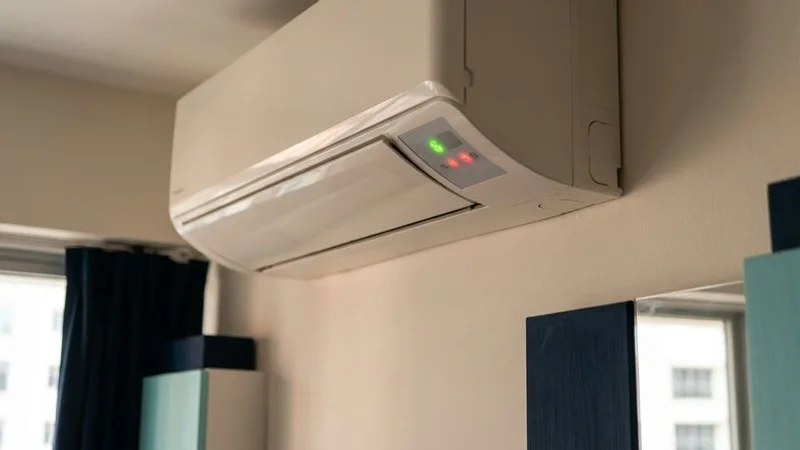
An aircon that suddenly starts flashing a little LED at you looks like a minor annoyance, right up until you realise the unit has stopped cooling. That blinking light is not random. It is the unit’s built-in diagnostic system trying to hand you a clue before you even pick up the phone to call a technician.
At CoolX Aircon, we treat those flashes the same way a mechanic treats an engine warning light: a structured message you can decode once you know the language. This guide walks through the most common patterns for every major brand sold in Singapore, the home checks that solve the problem about a third of the time, and the warning signs that should send you straight to a professional.
How Your Aircon Talks to You
Every modern split unit has a printed circuit board inside the indoor housing. The board watches temperature sensors, fan rotation, and refrigerant pressures many times per second, and it reports anomalies in one of three ways:
- A blinking LED that flashes a specific number of times and repeats
- An alphanumeric code on a digital panel or the remote screen
- A series of audible beeps emitted when a diagnostic button is pressed
The code itself does not fix anything. It tells you where to look. That alone saves significant time when a technician arrives on site, because parts and tools can be prepared in advance.
Reading Codes by Brand
Every manufacturer speaks its own dialect. A three-flash sequence means one thing on a Daikin and something entirely different on a Mitsubishi Starmex. Below is a summary of what our crews see most frequently across Singapore homes.
Daikin
Daikin gives you two paths to the error code. The indoor LED flashes a general fault, and the remote can be used to retrieve a more specific alphanumeric reading. Hold the Cancel button on the remote for roughly five seconds until 00 appears on the screen, then cycle through the codes until the unit emits a long confirmation tone.
| Code | What It Means | Typical Severity |
|---|---|---|
| A5 | Indoor freeze-up protection | Clean filters, check airflow |
| E3 | Outdoor high-pressure protection | Check outdoor condenser clearance |
| E7 | Outdoor fan motor fault | Professional replacement |
| F3 | Discharge pipe overheating | Blocked outdoor airflow |
| U0 | Low refrigerant detected | Leak test required |
| U4 | Indoor-outdoor signal failure | Wiring or PCB check |
A slow, rhythmic green pulse on a Daikin unit is standby mode. Only rapid flashing combined with loss of cooling indicates a problem.
Mitsubishi Electric (Starmex)
Mitsubishi uses flash counts on the operation timer LED. Count the flashes before the long pause and match them against this list:
- 2 flashes: Thermistor or louvre position fault
- 5 flashes: Outdoor power or inverter PCB error
- 6 flashes: Outdoor thermistor anomaly
- 7 flashes: Indoor fan motor failure
- Rapid continuous flashing: Power supply fault
The two-flash sequence is by far the most common, and the fix is sometimes embarrassingly simple. After a routine filter cleaning, the bottom louvre clasp must be firmly snapped back in place or the unit refuses to run. We have made more than one house call where the only “repair” was pressing the clasp shut.
The five-flash sequence is the one to worry about. Replacing an outdoor inverter PCB often crosses the S$700 mark, which makes an outright replacement worth considering on older units.
Panasonic
Panasonic systems prefix most codes with the letter H or F. Retrieve the exact code by pressing the small Check button on the remote control for five seconds, then cycling until the unit beeps four times.
| Code | Meaning |
|---|---|
| H11 | Indoor-outdoor communication failure |
| H14 | Indoor intake sensor fault |
| H15 | Compressor temperature sensor fault |
| F91 | Refrigerant cycle abnormality |
| F99 | Electrical peak current overload |
The H11 error is overwhelmingly common in older HDB blocks where the signal cable between indoor and outdoor units has corroded after years of exposure to Singapore’s humid air.
Samsung and LG
These two brands have mostly moved to full alphanumeric displays. Samsung shows codes like E101 and LG uses patterns such as CH05. Both brands also offer smartphone apps that listen through your phone microphone and decode the audio chime the unit emits during self-diagnosis. In our experience, these apps catch sensor faults reliably but are less accurate when the underlying issue is a refrigerant shortage.
Four Checks to Try Before You Book a Technician
Some flashing lights disappear after a proper reset. Try the following before scheduling a visit.
1. Hard Reset at the Isolator
Turning off the unit at the remote does not clear PCB memory. You need to kill power at the isolator switch mounted near the indoor unit, then wait a full 20 minutes for the internal capacitors to discharge. Restore power after the wait and see if the code returns. This alone clears about a third of transient faults.
2. Filter Inspection
A clogged filter chokes airflow across the evaporator, which then ices over and trips freeze protection. Pop the front cover, rinse the mesh screens in lukewarm water, dry them completely, and reinstall. Never slide a damp filter back into a unit, especially in our humidity.
3. Outdoor Unit Clearance
Walk around and look at the outdoor condenser. Loose plastic bags, bird nests, stacked storage, or overgrown plants all block airflow and trigger high-pressure faults. Keep at least 30cm of clear space around the fan. If you live on an upper floor, never lean out over the ledge. Just check visibly through the window.
4. Record the Pattern
Before calling for help, take a short video of the flashing sequence. Note the colour, count the flashes, and mention whether the unit still blows air. That data speeds up diagnosis enormously and often lets technicians bring the right parts on the first visit.
Red Flags That Mean Stop Using the Aircon
A handful of symptoms cross the line from inconvenient to genuinely dangerous. Cut power at the isolator and call a professional immediately if you notice:
- A burning plastic smell coming from inside the casing
- The main household breaker tripping whenever the aircon is switched on
- Rapid compressor cycling that sounds like the unit is slamming on and off
- Water visibly dripping over any electrical terminal
None of those are DIY territory.
The Cost of Ignoring the Warning
Running a unit that has flagged a fault is the fastest way to multiply your repair bill. A Daikin U0 low-refrigerant warning left unaddressed often ends with a seized compressor, turning a sub-S$150 gas top-up into a S$700 to S$1,000 compressor swap.
Similarly, an intermittent H11 communication error on a Panasonic almost always worsens with time. The loose connection arcs inside the wiring, degrades the insulation, and eventually damages the indoor PCB itself.
A standard diagnostic fee in the 2026 Singapore market sits between S$30 and S$50. That is small money compared to the damage a stubborn owner can cause by ignoring a flashing LED for weeks.
When the Codes Point to Bigger Problems
Blinking lights sometimes reveal underlying issues that surface cleaning will not fix. A recurring freeze-up code may point toward a slow refrigerant leak. Our guide on spotting refrigerant leak symptoms covers the signs to watch for. If the unit is genuinely not blowing cold air, a proper diagnosis is the only way forward.
If you have captured the blinking pattern and would like a professional read before replacing anything, reach out to our team. A short video and a few details about your unit model are usually enough for us to know what the call-out needs before we arrive.


About the Author
Kok Wai Keong
Founder & Principal Technician
Mr. Kok founded CoolX Aircon Servicing in 2016 after 15 years handling commercial and industrial cooling systems. He leads a team committed to eco-friendly maintenance and transparent pricing.