
An aircon that has lost refrigerant behaves in a very specific way. The fan still blows, the compressor still hums, and yet the room never quite cools down. This pattern trips up a lot of homeowners because the unit looks fine. Everything moves, everything lights up, and from the outside nothing seems broken.
At CoolX Aircon we diagnose these failures every week, and the symptoms are consistent enough that you can usually narrow down the problem before a technician even arrives. Here is what to look for, why it happens, and what a proper repair should actually involve.
A Crucial Distinction First: Weak Air vs Warm Air
Before anything else, pay attention to whether the air volume is low or whether the air temperature is wrong. These two symptoms point in completely different directions.
- Weak airflow with cold air: almost always a clogged filter, a dirty blower wheel, or a failing blower motor
- Strong airflow with warm or room-temperature air: almost always a refrigerant problem
A quick way to measure is the Delta T. A healthy split unit should deliver air 10 to 15°C colder than the room temperature. Place a digital thermometer near the supply louvres and compare it to the ambient reading. A gap of only 2 to 3°C means the system is struggling to absorb heat at the evaporator, which almost always traces back to low gas pressure.
The Five Signs of a Refrigerant Leak
1. Frost or Ice on the Copper Lines
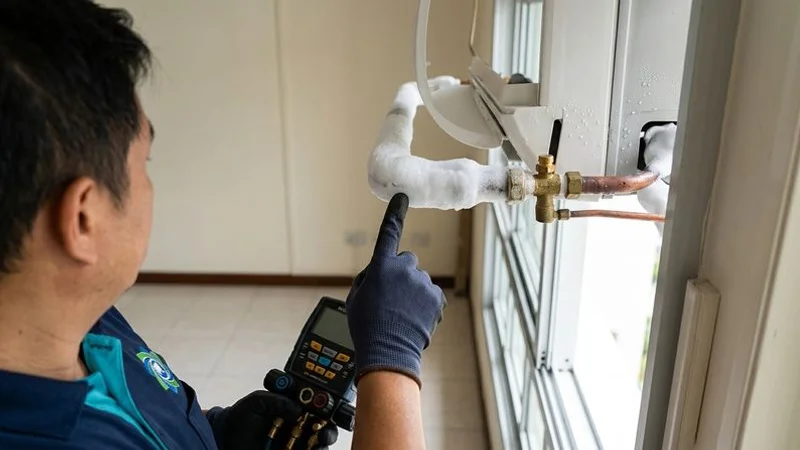
When refrigerant pressure drops below spec, the boiling point of the gas inside the evaporator falls below 0°C. Ambient humidity on the copper surface then freezes, forming a visible white frost or sometimes a solid ice block on the thinner liquid line. You can usually spot this either at the outdoor service valves or, in severe cases, directly on the evaporator fins when you lift the indoor cover.
Do not try to chip the ice off. Aluminium fins bend at the slightest touch, and a damaged evaporator is a much more expensive problem than a refrigerant top-up. Switch to fan-only mode for 30 minutes to let the ice melt naturally before any inspection.
2. A Sudden Gush of Water When You Switch Off
Water dripping from the indoor unit is usually a drain line problem, but there is one distinctive variant that points to low refrigerant. If your unit drips heavily only after you turn it off, you are watching accumulated ice melt faster than the drain pan can handle. A standard drain clog produces a steady drip while the unit is running; a refrigerant-related ice-melt dumps a sudden surge when the compressor cycles off.
| Symptom | Drain Clog | Refrigerant Shortage |
|---|---|---|
| Leak timing | Continuous drip during operation | Sudden gush after power-off |
| Supply air | Normal cold output | Near-ambient warm output |
| Visible clue | Jelly sludge in drain pan | Frost on copper lines |
3. The Compressor Never Rests
A correctly charged system reaches its target temperature and cycles down (non-inverter) or ramps to low output (inverter). A system starved of refrigerant can never absorb enough heat to hit the setpoint, so the compressor stays pinned at full output indefinitely. Listen to your outdoor unit from across the room. If it has been running at full volume for hours without changing pitch, the thermostat target is out of reach.
The financial cost of this is real. At Singapore’s 29.11 cents per kWh Q1 2026 tariff, an overworked compressor can add S$50 to S$100 a month to your bill. Worse, the continuous strain roughly halves the compressor’s lifespan. A unit that should last 10 years gets retired in four.
4. Faint Hissing or Bubbling Sounds
Refrigerant in a closed-loop system never gets consumed. If the level has dropped, it is physically escaping from somewhere. Small leaks at flare joints or along stressed copper sections sometimes produce an audible hiss when the compressor kicks in and the system pressurises.
A bubbling sound can also be heard at the flare nut connections on the outdoor unit when gas is seeping out. Our technicians carry electronic sniffers that detect leaks at concentrations far below human hearing, but an obvious hiss is a strong pre-visit clue.
5. Brand-Specific Error Codes
Modern units detect pressure anomalies before you notice any symptom. Check for these common codes:
- Daikin: U0 typically indicates low refrigerant
- Mitsubishi Electric Starmex: error 1301 flags a low-pressure fault
- Panasonic: timer light blinking, extract the full code via the remote’s Check button
- Samsung: E225 or similar pressure-related codes
- LG: CH53 or CH01 depending on model
If any of these appear and the unit stops cooling, assume a refrigerant issue until proven otherwise.
Why Does Gas Run Out?
A common myth is that aircons need annual gas refills like a car needs oil. They do not. The refrigerant loop is sealed at the factory and should last the entire life of the unit. Loss of pressure means something has physically breached the loop:
- Flare joint fatigue: brass connections loosen over years of thermal expansion and contraction
- Micro-cracks in copper: vibration and moisture create pinholes, especially in concealed pipe runs
- Evaporator corrosion: formicary corrosion from household cleaning products eats microscopic holes in aluminium fins
- Schrader valve failure: the service valve on the outdoor unit can leak over time, much like a bicycle tyre valve
Because the loop is sealed, topping up without finding and fixing the leak is a waste of money. You are simply paying to refill a system that will leak out again within weeks or months.
What Refrigerant Does Your System Use?
Singapore follows international phasedowns on high-GWP refrigerants. Here is the current landscape:
| Refrigerant | 2026 Status | Typical Top-Up Cost |
|---|---|---|
| R22 | Banned for new systems, scarce for repairs | S$100 to S$140 |
| R410A | Supply restricted, still used for existing systems | S$130 to S$170 |
| R32 | Current industry standard, lower GWP | S$130 to S$180 |
If your system still runs R22 and you are facing a leak, the repair economics often favour replacing the entire system with an R32 unit rather than chasing down a leak in a gas that is getting harder to source each year. Our refrigerant comparison guide covers the trade-offs in detail.
What a Proper Gas Top-Up Should Look Like
A legitimate repair follows a structured sequence. Be skeptical of any technician who skips steps.
- Pressure diagnosis: a manifold gauge is attached to the service valves to confirm the actual pressure deviation from spec
- Leak detection: an electronic sniffer or UV dye traces the escape point
- Targeted repair: flare joints are re-made, copper cracks are brazed, or components are swapped as needed
- Vacuum evacuation: the loop is pulled to a deep vacuum to remove air and moisture
- Weighed charging: refrigerant is added by weight according to the manufacturer’s data plate, not by guesswork
- Verification: a 20-minute run confirms the Delta T has returned to 10 to 15°C
Any contractor who skips the leak detection step is guaranteed to leave you with the same problem a few weeks later.
Cost Implications of Waiting
Running a starved system does not just waste electricity, it actively destroys the compressor. The compressor relies on returning refrigerant gas to cool its internal windings. Without adequate flow, the motor windings overheat and slowly fuse. A S$150 gas top-up caught early commonly turns into a S$800 to S$1,200 compressor replacement six months later when the unit finally dies.
If you suspect a leak, the cheapest path is also the fastest path: switch the unit off, book a diagnosis, and let a technician find and seal the breach before any more damage accumulates.
For a same-day assessment and an upfront quote, reach out to our team. Our full gas top-up service page lists the 2026 pricing openly so you know what to expect before booking.


About the Author
Kok Wai Keong
Founder & Principal Technician
Mr. Kok founded CoolX Aircon Servicing in 2016 after 15 years handling commercial and industrial cooling systems. He leads a team committed to eco-friendly maintenance and transparent pricing.