

A refrigerant is just the working fluid inside your aircon’s copper loop. It absorbs heat from your indoor air and releases it outside. Which specific chemical sits inside that loop matters enormously in 2026, because Singapore is in the middle of a regulated phase-out that has turned what used to be a boring maintenance detail into a real decision point for homeowners.
At CoolX Aircon we get asked about refrigerant types almost every week, usually by owners whose older units have sprung a leak and who are now trying to decide whether to repair or replace. This guide walks through the three refrigerants still in use, what each means for your wallet, and how to figure out what you currently own.
The Three Refrigerants You Will Encounter
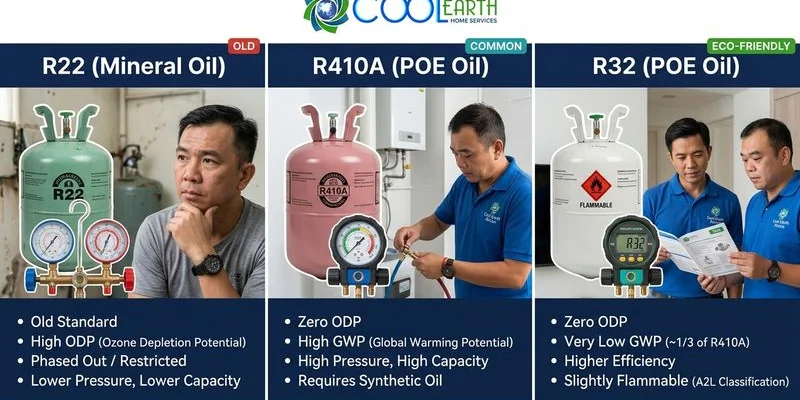
R22: The Old Workhorse
R22 dominated residential cooling in Singapore from the 1990s through the mid-2000s. It is effective, runs at relatively low pressures, and pairs with traditional mineral oils. Its one fatal flaw is the chlorine content, which damages the ozone layer. Under the Montreal Protocol, Singapore capped R22 imports years ago, and the remaining supply exists entirely as dwindling stockpiles.
If your unit was installed before 2010, it almost certainly uses R22. Servicing it today is still technically possible, but the cost curve is steep and going steeper each year as supply tightens.
R410A: The First Replacement
Around 2010, manufacturers shifted to R410A, a chlorine-free blend that eliminated the ozone problem entirely. The vast majority of residential units installed between 2010 and 2020 in Singapore HDB flats and condos run on R410A. It operates at higher pressures than R22, uses synthetic polyester (POE) oils instead of mineral oil, and is not directly interchangeable with its predecessor.
By late 2022, NEA effectively ended imports of new household systems using R410A, but existing stock and spare parts remain widely available for service work.
R32: The Current Standard
R32 is what you buy today. It is a single-component refrigerant with a Global Warming Potential of 675, roughly 68 percent lower than R410A. It also delivers about 10 to 15 percent better energy efficiency under typical residential conditions, which is why modern units from Daikin, Mitsubishi Electric, and Panasonic have standardised on it.
R32 is classified A2L, meaning mildly flammable. That sounds alarming but in practice the volume of gas in a home unit is tiny, and the Singapore Civil Defence Force has approved its residential use. The only real handling change is that technicians must use electronic leak detectors rather than the old flame-based tools, since any open flame near a fresh leak is obviously a bad idea.
Quick Comparison Table
| Property | R22 | R410A | R32 |
|---|---|---|---|
| Ozone depleting | Yes | No | No |
| Global Warming Potential | 1,810 | 2,088 | 675 |
| Operating pressure | Lower | Higher | Higher |
| Relative efficiency | Baseline | Good | Best (+10 to 15%) |
| Flammability class | A1 (non-flammable) | A1 | A2L (mildly flammable) |
| 2026 availability in Singapore | Restricted | Adequate | Excellent |
| Typical top-up cost (2026) | S$100 to S$140 | S$130 to S$170 | S$130 to S$180 |
What This Means in Practice
If You Still Own an R22 System
You are running on borrowed time, but that does not automatically mean you need to replace the unit tomorrow. Two scenarios:
Scenario A: Your R22 unit is still cooling properly and has not needed a top-up recently. Keep using it until something breaks. Regular servicing keeps it healthy, and you get to amortise the existing investment.
Scenario B: Your R22 unit has started leaking or needs frequent top-ups. The economics now tilt toward replacement. R22 is increasingly expensive, and every top-up without addressing the leak is money poured into a system that will leak out again. Our guide on spotting refrigerant leak symptoms covers what to watch for. Once you are top-up-twice-a-year territory, a full replacement with a 5-tick R32 system almost always pays back within a year or two of electricity savings.
Important constraint: you cannot retrofit an R22 system to run on R410A or R32. The operating pressures are incompatible, the copper piping specifications differ, and the lubricants react badly with each other. Replacement means replacing everything — indoor unit, outdoor unit, copper lines, and sometimes electrical work.
If Your System Uses R410A
You are in a comfortable middle position. R410A remains available for top-ups and repairs, and spare parts will stay in circulation for years. There is no urgent reason to replace a functioning R410A system purely for refrigerant reasons.
Stick with routine servicing and address leaks promptly. Replacement decisions should come down to the unit’s overall age and condition rather than the refrigerant type alone.
If Your System Uses R32
You are running the most efficient consumer technology currently available in Singapore. R32 is widely stocked, certified technicians are trained to handle it safely, and efficiency gains compound nicely against rising electricity tariffs. Make sure any service technician you hire is certified to work with A2L refrigerants, and insist on electronic leak detection rather than older flame-based methods.
How to Identify Which Refrigerant You Have
Finding this out takes about 30 seconds.
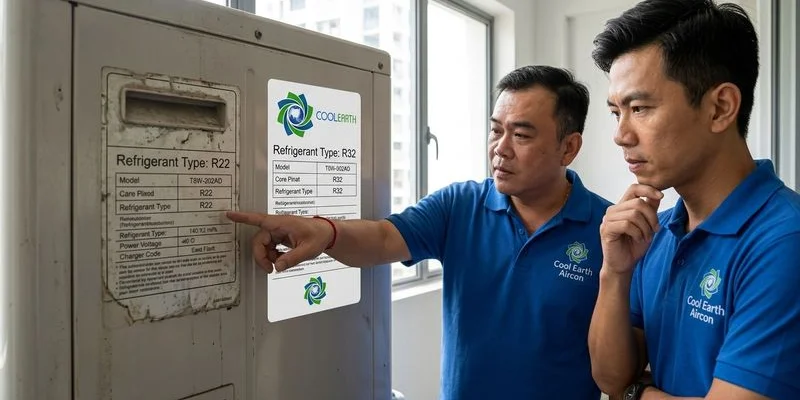
- Locate the outdoor condenser unit
- Look for a metal data plate, usually on the side or the top panel
- Find the “Refrigerant” or “Gas Type” field
- Note the code listed (R22, R410A, R32, or occasionally R407C for older commercial systems)
If the plate has faded in the sun, you can usually infer from installation date:
- Pre-2010 install: almost certainly R22
- 2010 to 2018 install: most likely R410A
- 2019 onwards: most likely R32
If you genuinely cannot tell, any professional technician can confirm the gas type during a standard service visit by checking the pressure signature and valve fittings.
Never, Ever Mix Refrigerants
This warning deserves its own section because we still occasionally see horror stories. Each refrigerant is paired with a specific lubricant (mineral oil for R22, synthetic POE for R410A and R32), and mixing them creates a sludge that coats the internal surfaces of the compressor and destroys it within hours.
Any contractor who suggests topping up your R22 system with R32 to save money is either uninformed or dishonest. The consequences include:
- Immediate loss of cooling capacity
- Compressor seizure within days or weeks
- In the worst case, ruptured copper lines under unexpected pressure
The only safe approach is to stick with the original refrigerant your system was designed for, or to replace the entire system.
The Replacement Math
For an R22 system that has started needing regular service, the replacement calculation is straightforward. The typical annual electricity bill for a 3-tick R22 multi-split system is noticeably higher than a modern 5-tick R32 equivalent. Our estimates suggest a household saving of S$300 to S$600 a year on electricity alone, depending on usage patterns.
Combine that with avoiding the rising cost of R22 top-ups and parts, and a replacement pays itself back within two to three years for most owners. The break-even calculation shifts in favour of replacement faster when:
- The existing unit is more than 12 years old
- A major component (compressor, PCB, or blower motor) has already failed
- Monthly electricity bills have been creeping up without usage changes
- The copper piping shows signs of corrosion or damage
Looking Ahead
The regulatory direction in Singapore is clear. R22 will eventually become unservicable as stockpiles run out completely. R410A will follow on a longer timeline. R32 is the current endpoint, and while future regulations may eventually push toward even lower-GWP alternatives, that transition is still years away.
For most homeowners, the practical answer is simple: keep what you have running well, and when the time comes to replace, buy R32.
If you are unsure which refrigerant your system uses or whether an upgrade makes financial sense for your household, reach out to our CoolX Aircon team for a no-obligation assessment. Our gas top-up service pricing is listed transparently so you can compare repair costs against replacement quotes without any guesswork.

About the Author
Kok Wai Keong
Founder & Principal Technician
Mr. Kok founded CoolX Aircon Servicing in 2016 after 15 years handling commercial and industrial cooling systems. He leads a team committed to eco-friendly maintenance and transparent pricing.