
An aircon purchase sticks with you for a decade, sometimes longer. Get it wrong and you spend the entire lifespan staring at a unit that cools badly, costs too much to run, and never quite earns its keep. Get it right and you barely think about it again until the next maintenance visit.
At CoolX Aircon, we have walked hundreds of Singapore homeowners through exactly this decision. Our focus is always the “Cool Earth” angle: help buyers choose equipment that runs efficiently, lasts longer, and keeps carbon footprints modest. Below is the step-by-step playbook we actually use when advising clients.
Start With a Property Reality Check
The first mistake most buyers make is shopping for a model before understanding their home. HDB blocks have strict rules about bracket types, electrical loading, and condenser placement. Private condos layer in their own Management Corporation Strata Title (MCST) restrictions on top of that.
Before visiting any showroom, measure three things: the available ledge space for outdoor units, the distance from each bedroom to that ledge, and the electrical amperage headroom in your distribution board. If any of these numbers surprise you, the answer to “what should I buy” changes immediately.
Step 1: Pick a System Architecture
Multi-Split Is the Default
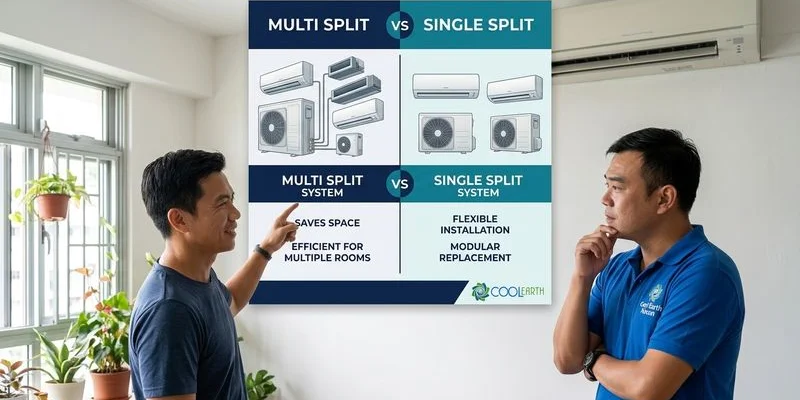
The standard solution for most modern homes is a multi-split setup, where one outdoor condenser connects to multiple indoor units through refrigerant piping. Configurations labelled “System 3” or “System 4” cover three or four indoor blowers respectively.
This architecture works in most four-room HDB layouts and almost every condo. The advantages are hard to beat:
| Multi-Split Strengths | Multi-Split Trade-Offs |
|---|---|
| Cost-effective for whole-home cooling | Each indoor unit needs separate servicing |
| Widest selection of 5-tick NEA models | Requires usable ledge space outside |
Single-Split for Targeted Cooling
One outdoor unit connected to one indoor blower. This makes sense for isolated study rooms, home offices, or small server closets. The catch is that each indoor unit demands its own bulky outdoor condenser, which eats ledge space quickly in stacked applications.
Ducted and Centralised
Concealed ducted systems cool an entire home through hidden vents. They look clean and run quietly, but they require ceiling height most HDB flats simply do not have. Costs jump significantly and zoned control becomes harder.
Step 2: Get BTU Sizing Right
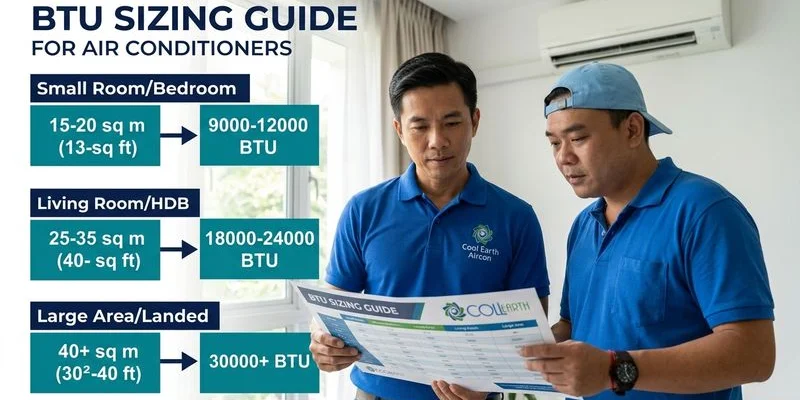
British Thermal Units (BTU) measure cooling capacity, and picking the wrong number wastes money either way. Undersized units run non-stop without reaching the set temperature. Oversized units short-cycle and fail to dehumidify properly in our tropical climate, leaving rooms feeling clammy even when the air is cold.
| Room Size | Recommended BTU | Typical Room Type |
|---|---|---|
| 10 to 15 sqm | 9,000 BTU | Small bedroom, study |
| 15 to 25 sqm | 12,000 BTU | Master bedroom |
| 25 to 35 sqm | 18,000 BTU | Standard living room |
| 35 to 50 sqm | 24,000 BTU | Large open-plan living area |
Two factors push you higher than the baseline. West-facing rooms that absorb direct afternoon sun typically need 10 to 15 percent more capacity. Units sitting directly above a hot kitchen or below an uninsulated roof need a similar bump.
When your calculation falls between two sizes, always round up. The small cost difference is negligible compared to the frustration of a unit that cannot keep up on a 32°C afternoon.
Step 3: Commit to Inverter Technology
The inverter question is essentially settled in 2026. Modern variable-speed compressors adjust their output continuously to match cooling demand, consuming 30 to 50 percent less electricity than older fixed-speed models.
The price premium of S$200 to S$400 per unit is recovered within 18 to 24 months of normal residential use. Our detailed comparison of inverter versus non-inverter systems breaks down the numbers further. For almost any residential application, the answer is inverter.
The 5-Tick Edge
NEA energy labels display efficiency using tick ratings from one to five. Since April 2025, new multi-split systems sold in Singapore must achieve a minimum 5-tick rating, which has effectively made 5-tick the new floor rather than the ceiling.
Upgrading from a 3-tick to a 5-tick system saves a typical household around S$300 per year in electricity. Over a 10-year lifespan, that more than covers the price premium.
Step 4: Choose a Brand
Premium Japanese
Daikin and Mitsubishi Electric dominate the premium residential segment for good reason. Daikin’s iSmileEco line offers strong efficiency plus built-in PM2.5 filtration through its Streamer Discharge technology. Mitsubishi’s Starmex series remains the go-to for light sleepers, with some models running as quietly as 19 decibels indoors.
Reliable Mid-Range
Panasonic’s latest XU series uses nanoe-X technology to neutralise airborne pollutants and delivers strong inverter performance at a slightly lower price. LG offers excellent smart home integration for users who live in their phones. Samsung’s Wind-Free technology disperses cold air through micro-holes, which suits anyone bothered by direct cold drafts.
Budget Picks
Midea has genuinely improved its build quality and offers good baseline cooling at lower prices. The trade-off is less advanced filtration and smart features. Reasonable choice for infrequently used guest rooms or investment properties.
Step 5: Budget Honestly
A transparent budget prevents painful surprises. These 2026 total installed prices cover a standard multi-split setup:
| Configuration | Budget | Mid-Range | Premium |
|---|---|---|---|
| System 2 | S$1,800 to S$2,200 | S$2,200 to S$3,000 | S$3,000 to S$4,000 |
| System 3 | S$2,500 to S$3,000 | S$3,000 to S$4,000 | S$4,000 to S$5,500 |
| System 4 | S$3,200 to S$3,800 | S$3,800 to S$5,000 | S$5,000 to S$7,000 |
These figures cover equipment and standard trunking. Extended pipe runs, concealed piping, and custom stainless steel bracket work all add to the final invoice. For the full breakdown of how installers price their work, see our aircon installation cost guide.
Step 6: Know Your Building Rules
HDB Regulations
Condenser weight limits typically sit between 80 kg and 110 kg per wall panel depending on the block type. Pipes must run in approved trunking unless you are doing a full renovation that can accommodate concealed runs. Older flats may also hit their electrical loading limits with larger systems, forcing a compromise on system size.
Condo Restrictions
Most MCSTs dictate exact condenser placement to preserve the building façade. You also need to comply with BCA noise limits of 65 decibels during the day and 55 decibels at night. Quality inverter units clear these comfortably. Check whether your condo runs a centralised chilled water system before buying any split unit, since that changes the calculation entirely.
Final Word
Take your time with this decision. Always ask for quotes that list specific model numbers, piping length, trunking material, and warranty terms. A quote missing any of these is incomplete and usually hides cost trade-offs.
When you are ready for a proper assessment, reach out to our team for a complimentary on-site evaluation. We will help you balance comfort, efficiency, and budget against your exact layout.

About the Author
Kok Wai Keong
Founder & Principal Technician
Mr. Kok founded CoolX Aircon Servicing in 2016 after 15 years handling commercial and industrial cooling systems. He leads a team committed to eco-friendly maintenance and transparent pricing.