
“Inverter” gets thrown around on every aircon spec sheet in Singapore, but most buyers never ask what the word actually means or whether the premium is still worth paying in 2026. This article answers both questions without the marketing fluff.
At CoolX Aircon we install, service, and repair both types of system regularly. What follows is the technical explanation in plain English, the real electricity numbers at current SP tariffs, and the handful of situations where a non-inverter unit still makes financial sense.
Two Different Philosophies of Cooling
The Fixed-Speed Compressor
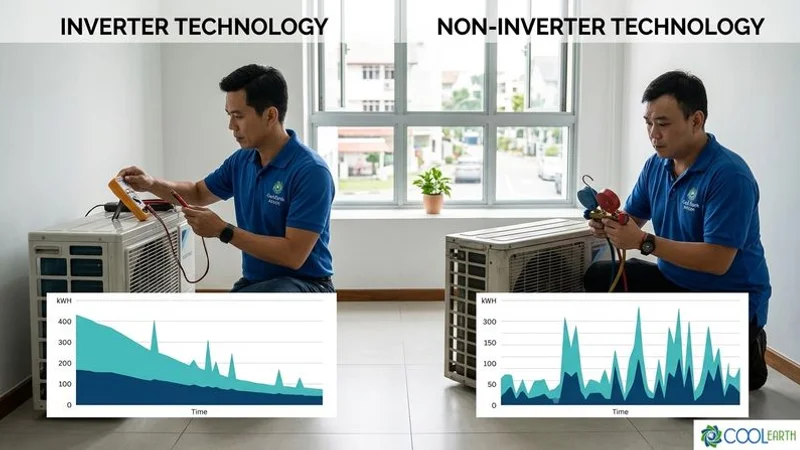
A traditional non-inverter unit has exactly two states: compressor on, running flat out, or compressor off, doing nothing. When you set the remote to 24°C, the compressor slams on at full capacity and cools the room until the thermostat detects the target temperature. Then it shuts down completely. When the room warms back up a few degrees, the cycle repeats.
Imagine driving a car where your only options are full throttle or coasting in neutral. That is what a fixed-speed compressor does all day. It works, but it is inefficient, noisy at startup, and produces uneven temperatures.
The Variable-Speed (Inverter) Compressor
An inverter unit uses power electronics to smoothly control compressor speed from about 10 percent up to 100 percent of maximum capacity. When you first switch the unit on, it ramps quickly to high output to cool the room down. Once the target is reached, it drops to a low maintenance speed that just counters the heat leaking back into the room. If someone opens a door, it ramps up briefly; if the room is perfectly stable, it purrs along at the minimum.
The car analogy here is cruise control. Smooth, continuous adjustment, no slamming between extremes. The same logic that makes highway driving more fuel-efficient than stop-and-go traffic applies to your aircon’s power bill.
How Each Type Feels in Daily Use
Temperature Stability
A fixed-speed system produces sawtooth temperature curves. You set 24°C, but the actual room temperature swings between roughly 22°C and 26°C as the compressor cycles. Most people sleep through the warm phases and feel chilled during the cold phases, which is why so many long-time fixed-speed owners wake up feeling either sweaty or frozen.
An inverter holds the room within about 0.5°C of the set point continuously. The air just feels right rather than bouncing around.
Noise
Fixed-speed compressors startle people. The mechanical clunk of a full-power startup in a quiet bedroom at 3am is impossible to ignore. Inverters ramp up smoothly and, during their low-speed maintenance phase, drop to noise levels that are barely audible.
Premium inverter models from Mitsubishi Electric (Starmex) and Daikin (iSmileEco) run as low as 19 decibels indoors. For context, that is quieter than whispered conversation.
Electrical Behaviour
A fixed-speed startup draws an inrush current six to eight times the normal running amps. Happening dozens of times per day, this puts cumulative stress on start capacitors, contactors, and wiring. Inverters ramp voltage gradually and entirely avoid those surges, which generally translates into better longevity for most electrical components.
The Real Electricity Numbers
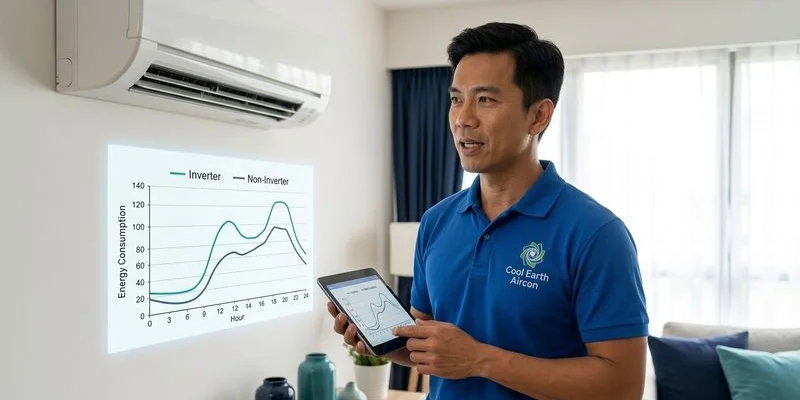
Let us put this into concrete 2026 Singapore numbers. Assume a 12,000 BTU bedroom unit running 8 hours a night at the Q1 2026 SP tariff of 29.11 cents per kWh.
| Metric | Older Non-Inverter (2-Tick) | Modern Inverter (5-Tick) |
|---|---|---|
| Average Draw | 1.0 kW | 0.6 kW |
| Daily kWh | 8.0 | 4.8 |
| Monthly kWh | 240 | 144 |
| Monthly Cost | S$69.86 | S$41.92 |
The per-unit monthly gap is just under S$28. Multiply that across a System 3 household (three bedrooms with three indoor units) and you are looking at roughly S$84 a month, or more than S$1,000 a year in electricity alone.
The price premium for a 5-tick inverter System 3 versus a budget model is typically S$600 to S$1,000 upfront. Even in the worst case, the upgrade pays itself back within the first year of use.
When the Inverter Premium Is Worth It
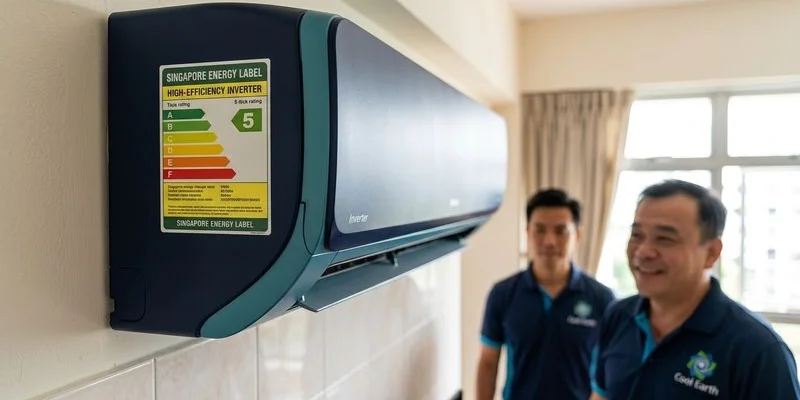
For almost any residential buyer in Singapore in 2026, the answer is yes. The technology has matured, pricing has fallen, and NEA regulations have effectively phased out most new non-inverter multi-split systems anyway. Since April 2025, new multi-splits sold locally must achieve a minimum 5-tick rating, which only inverter designs can hit.
A few specific scenarios still favour the older technology:
Short-Term Leases
If you are a tenant with a lease under 18 months and you are paying for the installation yourself, the payback period may outlast your tenancy. A lower-cost fixed-speed unit in a secondary market or a used system can make financial sense in this narrow case.
Guest Rooms Used a Few Times a Year
A holiday home or a spare room used for visiting family once every few months will never accumulate enough runtime to recover the inverter premium through electricity savings alone. The comfort advantage still exists, but pure ROI math tilts the other way.
Immediate Replacement on a Tight Budget
If a compressor has just failed during a heatwave and you need cooling restored today with the lowest possible upfront cost, a basic unit is still better than no unit. The long-term economics lose, but in an emergency the short-term math wins.
In every other situation, an inverter system is the rational pick.
The One Real Risk with Inverters
Inverters have one weakness that fixed-speed systems do not share: the printed circuit board. This is the computer that controls variable-speed operation, and it is sensitive to power surges, voltage fluctuations, and humidity. When an inverter PCB fails outside its warranty period, replacement costs currently sit between S$350 and S$600 for an indoor board, and even higher for an outdoor controller.
The good news is that modern PCB designs are reliable when properly maintained. Regular professional servicing keeps moisture out of the electrical compartment, and a stable household power supply (no heavy motor equipment on the same circuit) prevents surge-related damage.
Reliability and Lifespan
Our service records across Singapore HDB and condo installations show a clear pattern. A fixed-speed system under typical residential use lasts roughly 8 to 10 years before major component failure. An inverter system under the same usage pattern typically reaches 10 to 15 years, and sometimes longer with diligent maintenance.
The longer lifespan is worth real money when you factor in deferred replacement costs. Stretching a replacement cycle from 9 years to 13 years effectively cuts your long-term capex by about 30 percent.
Our Recommendation
For any Singapore household replacing or buying new equipment in 2026, default to an inverter system with the highest tick rating you can afford. The electricity savings cover the premium within a year or two, the comfort improvement is immediately noticeable, and the extended lifespan keeps paying dividends long after the initial investment.
If you are replacing a tired fixed-speed unit that has become a maintenance headache, the upgrade almost always makes sense. For advice on specific brands and models, our guide on choosing the right aircon for your HDB or condo covers the shortlist we typically recommend to clients.
For a tailored assessment of your current system and an upgrade quote, reach out to our CoolX Aircon team. A professional installation assessment is complimentary and usually pays for itself many times over in equipment lifespan alone.

About the Author
Kok Wai Keong
Founder & Principal Technician
Mr. Kok founded CoolX Aircon Servicing in 2016 after 15 years handling commercial and industrial cooling systems. He leads a team committed to eco-friendly maintenance and transparent pricing.