
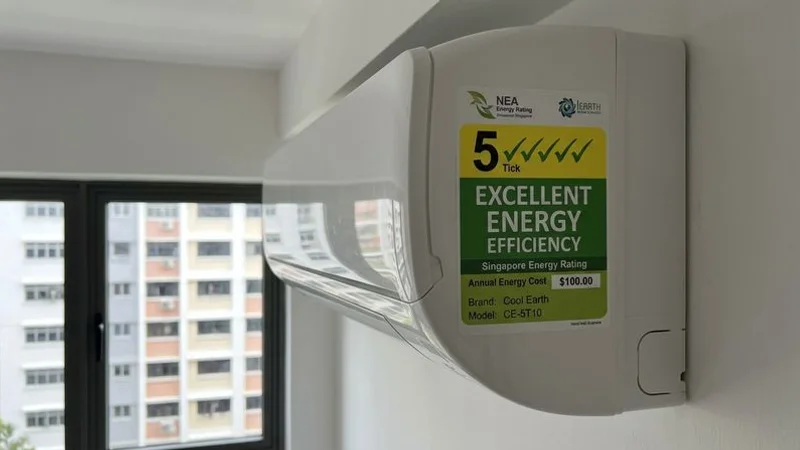
Walk into any aircon showroom in Singapore and you will spot the same green sticker on every display unit. A row of ticks, an annual kWh figure, a projected yearly cost in dollars. Most shoppers glance at the tick count, assume more ticks means cheaper to run, and buy the unit. That shortcut is mostly right, but it skips the details that actually determine your long-term electricity bill.
At CoolX Aircon we walk clients through these labels all the time, and the same misconceptions come up over and over. This guide unpacks each section of the label so you can read it properly and catch the traps that cost buyers real money.
What the Label Actually Is
The energy label on every split system sold in Singapore is a legal requirement under the Energy Conservation Act, administered by the NEA. It is not marketing material. The data on it is tested under standardised laboratory conditions, which makes it comparable across brands.
As of April 2025, the NEA significantly raised the Minimum Energy Performance Standards (MEPS) for residential cooling:
- Single-split systems: minimum 4 ticks to be legally sold
- Multi-split systems: minimum 5 ticks to be legally sold
- Portable aircons: minimum 1 or 2 ticks depending on category (new in 2024)
This means any brand-new multi-split unit you find in a 2026 showroom will be at least 5 ticks by default. The scale did not get easier to climb, the bar simply moved up.
The Five Pieces of Data on Every Label
The Tick Rating
The most visible part of the label is the row of green ticks, ranging from 1 to 5. The tick rating summarises the unit’s Cooling Seasonal Performance Factor (CSPF), which measures how much cooling output you get per unit of electricity across a range of typical operating conditions.
Here is the important caveat: tick thresholds have been tightened multiple times since 2014. A unit that earned 4 ticks in 2018 might only earn 2 or 3 under the 2026 bar. When comparing a showroom model with an older unit you already own, never trust the tick count across model years. Look at the kWh number instead.
Annual Energy Consumption (kWh/year)
This number is the real workhorse of the label. It tells you roughly how much electricity the unit is expected to draw over a year of standardised usage, typically assuming 1,820 hours of cooling per year. It is calculated under consistent lab conditions and is the most reliable apples-to-apples number on the label.
The caveat is that your actual usage almost never matches the test conditions exactly. If you run the aircon 12 hours a day instead of 8, scale the number up proportionally. If your room is poorly insulated or faces direct afternoon sun, expect another 10 to 20 percent on top. Use the printed figure as a comparison tool, not a guaranteed monthly bill.
Annual Energy Cost
This is the projected yearly electricity cost in Singapore dollars, derived by multiplying the kWh figure by whatever the electricity tariff was on the day the label was printed. Herein lies the trap: electricity tariffs change every quarter, so this number is almost always outdated.
The 2026 Q1 SP Group tariff is 29.11 cents per kWh. To recompute the cost for current tariffs:
Yearly Cost = Annual kWh × S$0.2911
A unit rated at 800 kWh per year costs roughly S$233 at 2026 rates, which works out to about S$19.40 per month.
Cooling Capacity
Capacity is expressed in BTU per hour or kilowatts. This is the amount of heat the unit can remove from the room per hour at full output. For Singapore HDB and condo rooms:
- 9,000 BTU suits a typical bedroom (12 to 15 sqm)
- 12,000 BTU suits a master bedroom (15 to 20 sqm)
- 18,000 BTU or larger suits open-plan living areas
Buying undersized capacity to save money is one of the most expensive mistakes we see. An undersized unit runs at full output continuously, never reaches the target temperature, and destroys the compressor from overwork. Any efficiency advantage evaporates within the first few years.
EER / COP
The Energy Efficiency Ratio (for cooling only) and Coefficient of Performance (general) express the ratio of cooling output to electrical input. Higher is better.
- An EER of 3.0 means 3 watts of cooling for every 1 watt of electricity
- An EER of 4.0 means 4 watts per 1 watt, roughly 33 percent more efficient
Under the 2025/2026 MEPS, a new split-type inverter must achieve a weighted COP of at least 4.04 just to qualify for the lowest legal tier. If you are comparing two units with identical tick ratings, the one with the higher COP is the technically superior choice.
Concrete Dollar Comparisons
Let us put this into practice. Imagine a standard 12,000 BTU bedroom unit running 8 hours a day at the 2026 tariff:
| Tick Rating | Est. Annual kWh | 2026 Cost | Savings vs 1-Tick |
|---|---|---|---|
| 1 tick (legacy) | 1,100 kWh | S$320 | Baseline |
| 2 ticks | 950 kWh | S$277 | S$43/year |
| 3 ticks | 830 kWh | S$242 | S$78/year |
| 4 ticks | 720 kWh | S$210 | S$110/year |
| 5 ticks | 620 kWh | S$181 | S$139/year |
Over a 10-year lifespan, a 5-tick unit saves roughly S$1,400 compared to an old 1-tick system. Even the gap between a 3-tick and a 5-tick model is about S$610 over a decade, which meaningfully exceeds the typical S$200 to S$400 price premium.
The Mistakes That Cost Real Money
Comparing Across Capacity Bands
Tick ratings are assigned within capacity categories, not across them. A 5-tick 24,000 BTU unit still uses far more electricity than a 3-tick 9,000 BTU unit, because the larger machine does more work. Always pick your correct BTU first, then compare ticks within that category.
Trusting the Printed Dollar Figure
The label’s annual cost is frozen at whatever tariff was valid on the printing date. Pull out your phone, grab the kWh number, and multiply by the current SP tariff for an accurate 2026 projection.
Assuming Ticks Are Eternal
Two units both labelled “4 ticks” may have been rated under different threshold years. A 4-tick unit from 2017 is efficiency-wise closer to a 2-tick unit by today’s standards. Always cross-check the model year and the actual kWh figure.
Forgetting Installation Quality
A 5-tick multi-split system installed with thin pipe insulation, unnecessarily long copper runs, or a poorly ventilated outdoor ledge will underperform its label badly. The ratings assume proper installation conditions that many budget installers do not actually deliver. Good copper, proper insulation, and a clean condenser ledge can matter as much as the tick count itself.
Ignoring the EER When Ticks Tie
Two units at the same tick rating can still differ meaningfully on EER. When the ticks match, let the EER break the tie. The difference is small in raw numbers but compounds across years of usage.
Inverter versus Non-Inverter on the Label
Both types are rated on the same scheme, but real-world performance diverges from the label in opposite directions. Modern inverters tend to perform better than their label suggests under Singapore’s steady-state cooling needs, because their variable-speed operation smooths out the inefficiencies of traditional start-stop cycles. Non-inverters perform closest to their label only under very specific test conditions that rarely match actual residential usage.
For the deeper technical comparison, our article on inverter versus non-inverter aircons breaks down the differences.
Our Practical Recommendation
For almost any purchase in 2026, buy the highest tick rating your budget allows within the correct capacity band. The price premium for top-tier efficiency has narrowed considerably, and the electricity savings over a 10-year lifespan reliably exceed the upfront cost.
When comparing two finalists at the same tick rating, pick the one with lower annual kWh and higher EER. And no matter which unit you choose, spending carefully on a quality installation is just as important as the label on the box. A great unit poorly installed will underperform a modest unit installed properly.
If you would like help matching a specific model to your layout, reach out to our CoolX Aircon team for a walkthrough of your floor plan. Our full aircon installation service includes proper sizing, pipe routing, and verification that the system actually delivers the efficiency its label promises. For more ways to cut ongoing costs, see our guide on reducing your aircon electricity bill.


About the Author
Kok Wai Keong
Founder & Principal Technician
Mr. Kok founded CoolX Aircon Servicing in 2016 after 15 years handling commercial and industrial cooling systems. He leads a team committed to eco-friendly maintenance and transparent pricing.