

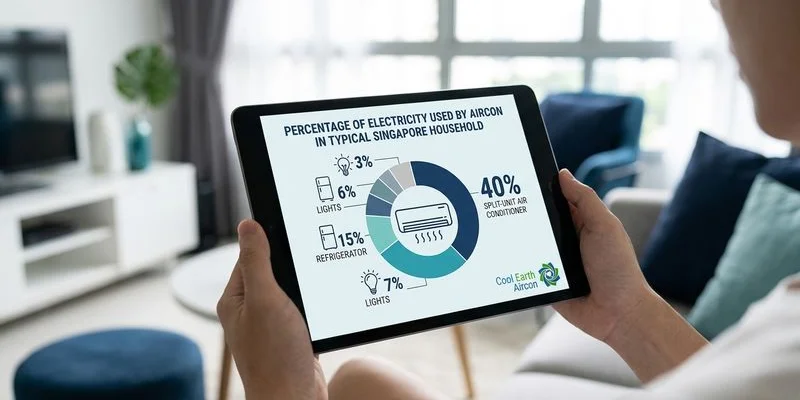
SP Group’s Q1 2026 tariff stands at 29.11 cents per kWh inclusive of GST, and cooling alone accounts for roughly a quarter of the average household’s monthly electricity use. For a typical three-bedroom HDB flat, that means S$80 to S$180 a month just keeping rooms comfortable. Trim that number meaningfully and you recover real money across a full year.
At CoolX Aircon we advise households on energy efficiency as part of almost every service visit. This guide pulls together the strategies that actually move the needle, ranked roughly by impact and grouped so you can start with the free changes before spending on hardware.
Free Changes (Start Here)
Set 24 to 25°C and Stop Going Lower
The single biggest waste we see is owners setting their remote to 18°C because they want the room to “cool faster”. It does not cool faster. A fixed-speed compressor runs at one speed regardless of your target, and an inverter compressor just keeps running longer at its peak output. All you achieve by dropping from 25°C to 18°C is 20 to 30 percent more electricity consumption for the same perceived comfort once the room equilibrates.
NEA’s Go 25 campaign is built around exactly this observation. Every degree above 25°C saves roughly 3 to 5 percent. Pair 24°C with a small standing fan and most people cannot tell the difference from 22°C without the fan, at a fraction of the power draw.
Use the Timer or Sleep Mode Every Night
Your body needs less cooling once you are deep in sleep. Modern split units from Daikin, Mitsubishi, and Panasonic include sleep modes that gradually raise the target temperature by 1°C per hour after you doze off, which is more or less ideal behaviour.
If your remote lacks a sleep mode, a simple two-timer approach works well: set the unit to 24°C at bedtime with a timer to switch off after four hours, and optionally schedule it to restart an hour before your alarm. This alone typically cuts overnight runtime in half.
Seal the Room Properly
A bedroom with the door cracked open or a gap under the door is a small hole pouring cool air into the corridor every minute the unit runs. The compressor responds by working harder. Three cheap fixes:
- Keep bedroom doors and windows firmly closed while the aircon is on
- Fit a silicone or rubber draft strip under doors (under S$10 at any hardware store)
- Draw blackout curtains on west-facing windows during the afternoon
Solar gain through a single-glazed HDB window is surprisingly heavy. Shaded rooms reach their target temperature in half the time.
Keep Top-of-Unit Airflow Clear
The indoor unit draws return air through the top grille, and if anything is blocking that intake (a tall wardrobe, a curtain, stacked storage boxes) the blower struggles to pull enough air across the evaporator coils. Clear at least 15cm of space above every indoor unit and keep heat-generating appliances (TVs, games consoles, lamps) out of the direct return path, since they trick the sensor into overcooling the room.
Low-Cost Maintenance Habits
Rinse Filters Every Two Weeks
A filter clogged with dust forces the blower to work harder while simultaneously starving the coil of airflow. A two-minute rinse under the tap brings performance back to baseline and takes no tools. Pet owners should tighten this to weekly because fur accumulates much faster than dust alone.
Book Quarterly Servicing
A professional service every three months catches coil grime and drain blockage before they cost you efficiency. Our internal records show that unmaintained units routinely draw 20 to 30 percent more power than clean systems of the same age. For a household running three indoor units, that waste easily crosses S$50 a month, more than covering the cost of professional care.
Add an Annual Chemical Wash
Routine servicing clears surface dust but cannot dissolve the sticky biofilm that builds on fins after a year of humid operation. An annual chemical wash (typically S$80 to S$130 per unit in 2026) resets the system and recovers the efficiency lost to biological grime. Our guide on servicing frequency covers the full schedule.
Medium-Cost Equipment Tweaks
Right-Size the System
An oversized unit short-cycles continuously, drawing a power surge every time the compressor restarts and failing to properly dehumidify the room. An undersized unit runs flat out without ever reaching the target, so owners push the set point lower and waste even more energy.
| Room Profile | Typical Size | Recommended Capacity |
|---|---|---|
| HDB common room | 12 to 15 sqm | 9,000 BTU |
| HDB master bedroom | 15 to 20 sqm | 12,000 BTU |
| Open living/dining area | 90 to 110 sqft equivalent | 18,000 to 24,000 BTU |
If you suspect your existing system is wrongly sized, our aircon selection guide walks through the proper BTU math.
Use Fan Mode Intelligently
The fan-only setting runs at roughly 30 to 50 watts compared to 800 to 1,200 watts when the compressor is actively cooling. Perfect for cool monsoon evenings when you just want air movement, or for a 10-minute post-cooling cycle that dries the evaporator coils and delays mould growth.
Larger Investments That Pay Back
Upgrade to an Inverter System
If your flat still runs a fixed-speed non-inverter unit, this is your biggest win. Variable-speed compressors modulate output to match actual demand, rather than slamming between full power and off. Real-world savings compared to a matched fixed-speed system typically land between 30 and 50 percent of cooling-related electricity.
A household spending S$180 a month on cooling often drops to S$90 to S$120 after an inverter upgrade. For the full technical comparison, see our article on inverter versus non-inverter aircons.
Chase the 5-Tick Rating
NEA energy labels rate units from 1 tick to 5 ticks. Since April 2025, new multi-split systems must achieve a minimum 5-tick rating, making it the baseline for fresh purchases. An older 3-tick unit still consumes around S$300 more per year than a 5-tick replacement, and that gap alone pays back the price premium well within the unit’s lifespan. Our guide on reading NEA tick labels has the full breakdown.
Putting It All Together
The point of this list is cumulative savings, not picking one tip. A household that:
- Moves from 20°C to 25°C with a supplementary fan (20% saving)
- Adopts a proper overnight timer (15% saving on overnight runtime)
- Commits to quarterly servicing and annual chemical washes (10 to 15% saving)
- Seals their bedrooms properly (5 to 10% saving)
…often cuts cooling-related electricity by 40 to 60 percent overall. On a S$150 monthly cooling bill, that is S$60 to S$90 a month back in the household budget, or more than S$1,000 over a year.
Start with the free adjustments because they cost nothing and take effect immediately. Layer in maintenance and sealing work next, and only consider hardware upgrades once you have squeezed every habit change for its worth.
If you want a professional assessment of your current system and a specific action plan for your household, reach out to our team for a walkthrough. The quickest wins usually do not cost anything at all.


About the Author
Kok Wai Keong
Founder & Principal Technician
Mr. Kok founded CoolX Aircon Servicing in 2016 after 15 years handling commercial and industrial cooling systems. He leads a team committed to eco-friendly maintenance and transparent pricing.